Kajabi vs Thinkific (2026): which fits you?
Kajabi and Thinkific compared in 2026: real prices, contact vs student caps, hidden fees, and when a standalone checkout does the same job for less.
 Jacob PegsFounder of Swipefast
Summary of the Article
Kajabi and Thinkific both teach courses well, but they solve different problems. Kajabi is an all-in-one: your website, email marketing, funnels and checkout all included. Thinkific is a course host you pair with other tools, which is why it looks cheaper on paper but often costs more once you add email and landing pages.
- Kajabi: best when you want everything in one place. Costs $143 to $399 a month (billed yearly), and contacts, not products, are the real ceiling.
- Thinkific: best when you already have an email tool and just need somewhere to host courses. Costs $82 to $374 a month (billed yearly), capped at 10,000 active students on every self-serve plan.
- Neither has a free plan in 2026, and both removed or raised their cheap entry tiers this year.
- If your main job is selling a product through a great checkout, a standalone checkout tool beside a simple course host can do the same job for less.
Both platforms raised prices in 2026 and moved their cheapest plans out of reach, so older articles you may have read are out of date. This one uses each company's own pricing page, checked in November 2026.
What you actually pay in 2026
Kajabi sells three main plans. Thinkific also sells three, plus an enterprise tier. Here are the prices straight from each pricing page.
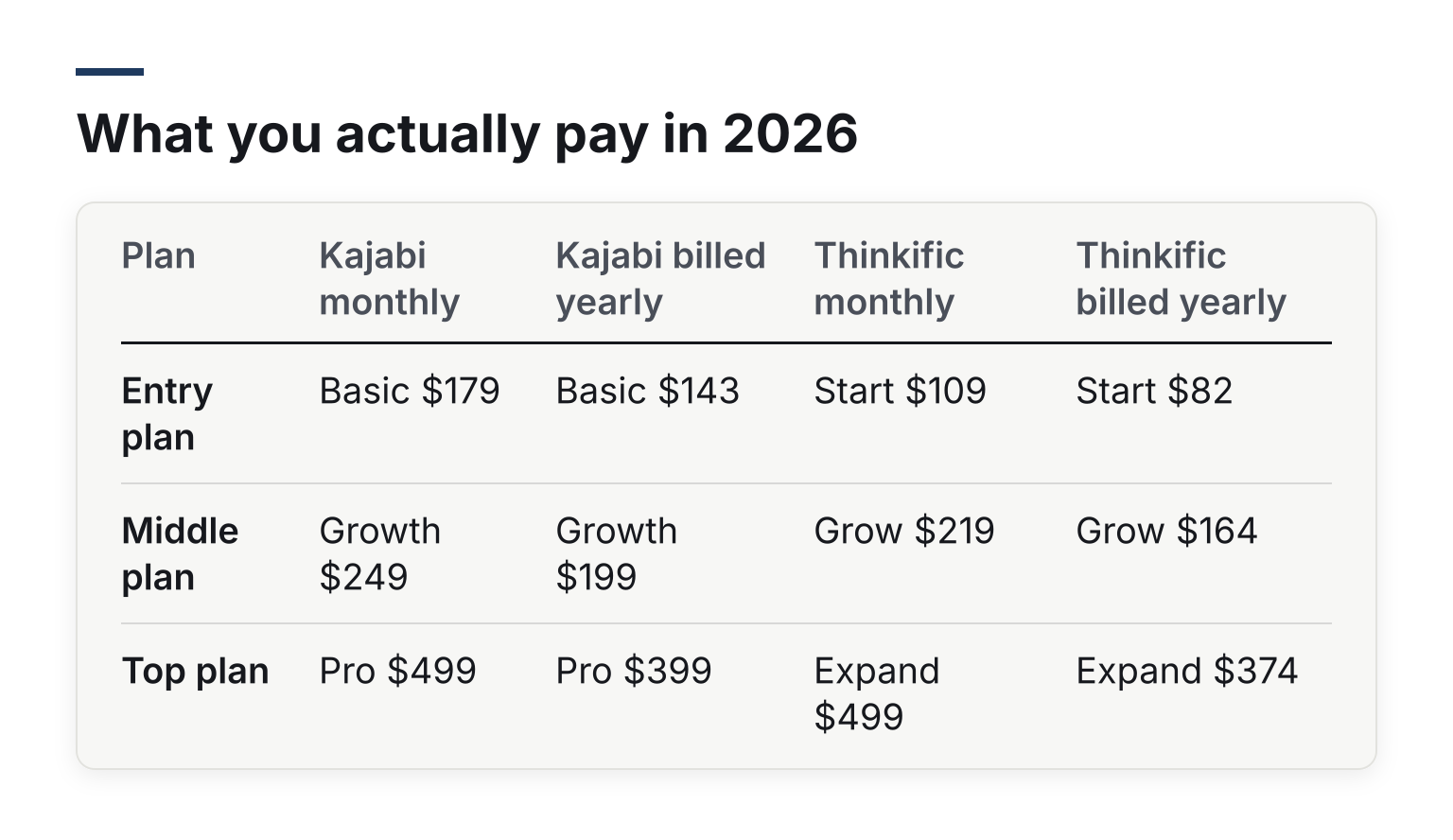
| Plan | Kajabi monthly | Kajabi billed yearly | Thinkific monthly | Thinkific billed yearly |
|---|---|---|---|---|
| Entry plan | Basic $179 | Basic $143 | Start $109 | Start $82 |
| Middle plan | Growth $249 | Growth $199 | Grow $219 | Grow $164 |
| Top plan | Pro $499 | Pro $399 | Expand $499 | Expand $374 |
Both companies raised prices and dropped or reshuffled their cheap entry plans in 2026. Thinkific retired its Basic plan (it last cost $54 monthly, $40 yearly), so Start is now the floor. Kajabi's help center still lists a legacy Kickstarter plan at $89 a month, but it no longer appears on the public pricing page, so new customers can't buy it. Treat any article that quotes either old tier as stale.
One thing to know before you compare those numbers: the annual prices are per month, billed once a year. Kajabi Growth is $199 per month billed annually at $2,388 for the year. If you pay monthly instead, it is $249 per month.
Sources: Kajabi's pricing page and Thinkific's pricing page.
Kajabi: what $143 to $399 a month gets you
Kajabi is the all-in-one: every plan includes your website with a custom domain, landing pages, funnels, a private community, checkout and unlimited email sends to the contacts your plan allows.
The ceiling is contacts, not customers. Basic includes 2,500, Growth 25,000, Pro 100,000. Free lead magnets grow your list fast, so plenty of sellers hit the Basic cap with only a handful of paying customers. When you do, Kajabi sells extra capacity in blocks of 25,000 contacts for $125 a month, which its own pricing FAQ states. At that point Growth is usually the cheaper move.
Also on Basic: one website and one community, and you can sell 5 products (Growth is 50, Pro unlimited). The branded customer app is included on every plan, but your own app store listing under your brand is Pro only. Live cohort courses and your own affiliate program start on Growth.
Thinkific: what $82 to $374 a month gets you
Thinkific is a course host plus a storefront. It hosts courses, memberships, communities and sales pages, and its commerce tools are solid. It does not do your email marketing or build your funnels; you bring an email tool like Kit and connect it yourself.
Its ceiling is students, not subscribers. Every self-serve plan tops out at 10,000 active students, meaning students who currently hold unexpired access to at least one course. It also meters your video bandwidth: 200 GB a month on Start, 400 GB on Grow, 1,000 GB on Expand. Video-heavy courses with lots of students can hit that wall. Communities run one on Start, three on Grow, ten on Expand.
The feature traps: bundles, memberships, subscriptions, payment plans and certificates all need Start or above, so there is no truly free selling tier anymore. Removing Thinkific branding, API access and webhooks, and PayPal support wait for Grow. The branded mobile app under your own name is a $199 a month add-on. Larger teams need Thinkific Plus, which has custom pricing and adds SCORM support, SSO, custom analytics and unlimited communities.
The real divide: all-in-one vs course host
This is the decision that matters more than any price tag.
Kajabi hands you the whole stack on day one: site, email, funnels, community, checkout, one login. If you have nothing yet and want one subscription to run everything, that is genuinely convenient.
Thinkific asks you to assemble the rest. You host courses there and connect your own email tool, landing pages and whatever else your funnel needs. Neither approach is wrong. The question is which gap you would rather fill: pay Kajabi to include everything, or pay Thinkific and wire up the pieces.
The fair comparison: same list size, same job
Sticker prices mislead because Kajabi's price already includes email, while Thinkific's does not. So here is the honest math. Kit (formerly ConvertKit) has a free plan for up to 10,000 subscribers with unlimited forms and broadcasts, confirmed on Kit's own help page, though automations and sequences need a paid plan. Check kit.com/pricing for current paid rates above that.
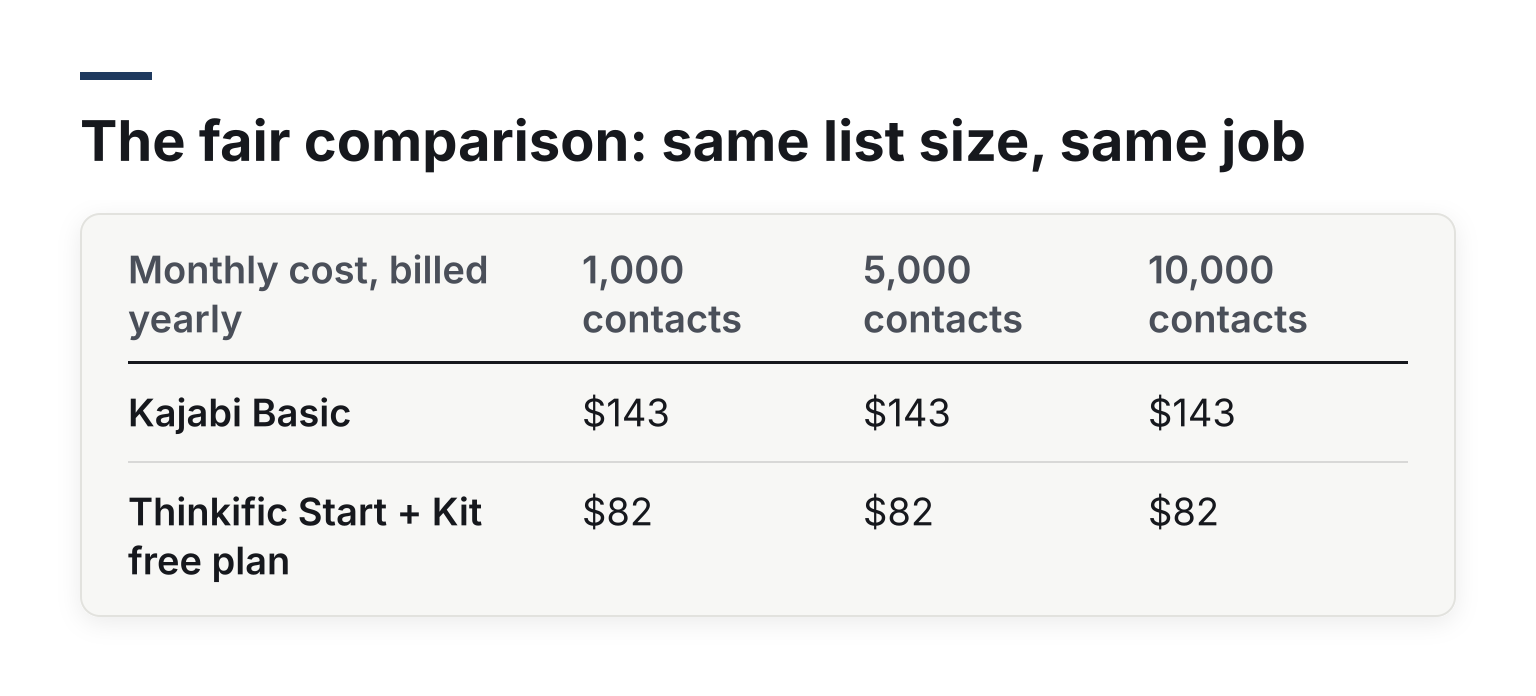
| Monthly cost, billed yearly | 1,000 contacts | 5,000 contacts | 10,000 contacts |
|---|---|---|---|
| Kajabi Basic | $143 | $143 | $143 |
| Thinkific Start + Kit free plan | $82 | $82 | $82 |
At list sizes up to 10,000, Thinkific Start plus Kit's free plan costs $61 a month less than Kajabi Basic. That gap is real money, roughly $732 a year. But note what you give up: Kit's free plan does not include visual automations or email sequences, so if your funnel depends on an automated welcome series, you will move to a paid Kit tier and the gap narrows.
Above 10,000 contacts the picture flips. Kajabi Growth at $199 covers up to 25,000 contacts with unlimited email sends. Thinkific caps every self-serve plan at 10,000 active students, and your email tool's bill now scales with your list on top of Thinkific's. Past 25,000 contacts, Kajabi's $125-a-month contact blocks kick in.
Fine print on fees
Neither platform charges you a platform transaction fee when you use its own payment system. The surprises sit elsewhere.
Kajabi: use Kajabi Payments and there is no platform surcharge, just standard card processing. Connect your own Stripe instead and Kajabi adds a fee of 2% on Basic, 1% on Growth, or 0.5% on Pro, per Kajabi's help center. That fee applies to every sale.
Thinkific: two fees hide in the fine print. First, using your own Stripe rather than Thinkific Payments triggers a third-party gateway fee of 2% on Start, 1% on Grow, and 0.5% on Expand, waived after your first $1 million in sales per calendar year, per Thinkific's fee FAQ. Second, Thinkific's Sales Tax and VAT solution adds a 0.5% fee on transactions where tax is assessed for students in the US, Canada, the UK, the EU and Switzerland, even when the calculated tax rate is zero.
In short: both platforms quietly prefer you on their own payment rails, and both charge you for the freedom to bring your own processor.
Checkout and sales features
For selling, here is where each stands on order bumps, one-click upsells, and payment plans, the three levers that raise average order value.
- Kajabi includes checkout, payment plans and subscriptions on every plan. Its upsell flow exists but is less flexible than a dedicated checkout tool's, and one-click post-purchase upsells are the area where Kajabi feels least mature.
- Thinkific puts bundles, upsells and payment plans on Start and above, which is genuinely good for a course host. But its upsell and bump tooling is thinner than checkout-first products, and some sales features tie you to Thinkific Payments.
Neither is a checkout specialist. If increasing order value is your main lever, that is exactly the gap dedicated checkout tools fill. We compare the options in our guide to the best order bump and upsell software for coaches.
Best fit by reader
Choose Kajabi if: you are starting from zero, want your website, email, funnels, community and checkout in one place, and your list will stay under roughly 25,000 contacts. You are paying for the all-in-one convenience, and it is worth it if you would otherwise juggle five subscriptions.
Choose Thinkific if: you already have an email tool you like, your course catalog is the product, and you will stay under 10,000 active students. Start at $82 billed yearly plus a free email plan is the cheapest legitimate way to sell structured courses in 2026.
Choose neither if: your real need is selling. Plenty of coaches and creators do not need Kajabi's marketing suite or Thinkific's classroom. They need a great checkout page that takes payments, adds bumps and upsells, handles payment plans, and sends money to their own Stripe or PayPal. If that sounds like you, our Kajabi alternative for a simpler checkout walks through this in detail, and our Stan Store vs Kajabi comparison covers when the all-in-one is simply unnecessary.
When a standalone checkout like Swipefast beats both
Here is the simpler alternative in concrete terms. Swipefast is checkout software, not a course platform. It builds branded checkout pages, with order bumps, one-click upsells, downsells, payment plans and subscriptions included on the $29 Starter plan. Sales go straight to your own Stripe or PayPal account, and Swipefast takes 0% of your revenue. There is a 7-day free trial, no free plan. Pair it with a lightweight course host, keep the email tool you already use, and you may never need an all-in-one at all.
Want to cost-check Kajabi against your own numbers first? Our Kajabi fee calculator shows your real monthly cost. And if you are weighing checkout tools generally, start with the best checkout software for coaches and course creators.
The verdict
Kajabi wins for beginners who want one subscription to run everything, as long as they accept that contacts are the ceiling. Thinkific wins for creators who already run their email elsewhere and need a serious course host without all-in-one pricing. But if selling, not teaching infrastructure, is your bottleneck, a standalone checkout like Swipefast at $29 a month with 0% of sales, bumps and upsells included may cover what you would pay either platform for.
Ready to try the simpler path? Start a 7-day free trial of Swipefast and have your first checkout live today.
Questions people ask before choosing
Is Thinkific cheaper than Kajabi?
On paper, yes. Thinkific Start is $82 a month billed yearly and Kajabi Basic is $143. Kajabi includes email marketing and Thinkific doesn't, so add your email tool's cost to Thinkific before comparing.
Does Kajabi or Thinkific take a cut of my sales?
Not on their own payment systems. Connect your own Stripe instead and both add a fee: 2% on the entry plan, 1% on the middle plan, 0.5% on the top plan.
Which has a free plan in 2026?
Neither. Thinkific retired its Basic plan, so Start is the cheapest, and Kajabi's legacy Kickstarter plan is no longer sold to new customers.