15 Scarcity Examples That Sell Digital Products |
Scarcity examples for digital product sellers: 15 honest urgency tactics and an ethics checklist, so your deadlines drive sales without fake timers.
 Jacob PegsFounder of Swipefast
Summary of the Article
Scarcity marketing gives people a reason to decide now instead of someday. For digital products, credible scarcity comes from time limits, capacity limits tied to your actual availability, and bonuses that expire, not from "only 3 left in stock" claims, because a digital file never runs out. Below are all 15 examples, grouped by where the limit comes from, plus an ethics checklist based on FTC guidance.
Deadlines on the calendar:
- Cart open, cart close launch windows: the classic launch deadline; revenue pauses while carts are shut.
- Cohort enrollment deadlines: the start date makes the deadline real.
- Personalized evergreen deadlines: each buyer gets a timer that truly expires and stays expired.
- Seasonal or annual reopens: the slowest-burning tactic, and among the most credible.
Limits on your time:
- Limited seats in a coaching program: if you can serve 20 clients, 20 spots is a fact, not a trick.
- Live workshop capacity: state the cap and the reason for it.
- Capped group Q&A or office hours: a real per-call limit, shown next to the feature.
- Audit or mock call slots: a fixed number of one-to-one reviews per launch.
Bonuses that expire:
- A limited-time bonus: urgency on the bonus, not the product itself.
- The expiring bonus stack: several small, real deadlines layered up; keep it to two or three.
- First-X-buyers bonuses: the limit is a count you track honestly, not a clock.
Price deadlines:
- Early-bird pricing: a lower price with a stated end date you actually honor.
- Price increase notices: a dated, kept promise that works well for subscriptions.
- Founding member pricing: cheaper, capped, and closed once full.
At the point of sale:
- Time-limited upsell offers: the "this page only" offer after purchase, where urgency is strongest.
Fake timers and manufactured limits do the opposite of what they promise: buyers notice, credibility drops, and refund requests climb. The FTC's September 2022 dark patterns report specifically calls out baseless countdown timers and false scarcity messages as deceptive.
What scarcity marketing is, and why it works
Scarcity is the principle that things feel more valuable when access to them is limited. In an example of scarcity you see every day: two seats left at a price, or a sale that ends Friday.
The psychology behind it is well studied. Loss aversion, the bias Daniel Kahneman and Amos Tversky documented, means the pain of missing out weighs roughly twice as much as the pleasure of gaining. The Nielsen Norman Group explains how this makes scarcity one of the strongest persuasion tools in interface design: a buyer who might otherwise "think about it" acts because waiting feels like losing something (NN/g on the scarcity principle).
It only works when the constraint is real. CXL's breakdown of scarcity examples notes that scarcity backfires when the limit feels manufactured, and that shoppers who catch one fake claim stop believing every claim you make after it.
Why digital products need a different playbook
Physical sellers can honestly say "only 1 left in stock." You can't. Your course, template, or ebook can be copied infinitely, so any inventory claim is either a lie or an obvious trick.
What is genuinely limited in a digital business:
- Your time. Coaching slots, live sessions, feedback, office hours.
- The calendar. A launch window, a cohort start date, a seasonal reopen.
- The deal. A bonus, an early-bird price, a bundle that ends.
Every credible tactic below ties urgency to one of those three. The fake ones don't.
The 15 scarcity examples
1. Cart open, cart close launch windows
Open sales on a Monday, close them Friday at midnight, and mean it. The deadline lives on your sales page with a countdown to the close. This is the classic launch model for courses and cohorts, and it's honest because the window genuinely ends.
The tradeoff: closed carts mean closed revenue between launches, so this suits offers you sell in waves rather than every day.
2. Cohort enrollment deadlines
A cohort starts on a date. Enrollments close a few days before, because onboarding, welcome calls, and the first module happen together. The deadline is real because the start date is real.
3. Limited seats in a coaching program
If you personally coach 20 clients, you can serve 20 clients. Say "20 spots, 7 left" and it's true. This is the strongest scarcity a coach has, because capacity is a fact, not a marketing device.
4. Live workshop capacity
A live workshop on Zoom has whatever cap you set, and a reason for it: you want everyone able to ask questions. State the cap and the reason. "40 seats so everyone gets their question answered" beats "40 seats left" with no explanation.
5. Capped group Q&A or office hours
If your offer includes monthly group calls with a per-call participant limit, that limit is a real, sellable scarcity. Put it on the sales page next to the feature, not buried in a footnote.
6. Audit or mock call slots
Offer a limited number of one-to-one audits, mock calls, or reviews as part of a program launch. If you can genuinely review 10 sales pages in a launch week, say "10 audit spots." When they're gone, they're gone, and buyers who missed one will happily join the next launch.
7. A limited-time bonus
Instead of pressuring people about the product, put the deadline on the bonus: "Enroll by Friday and you get the swipe-file pack." The product stays available, the bonus doesn't. This is the most comfortable urgency tactic for sellers who dislike hard deadlines, and it works because the reader loses something specific and visible.
8. The expiring bonus stack
Layer several bonuses that expire at different times: one at 48 hours, one at the cart close, one for the first 50 buyers. Each deadline is small and real. The risk is complexity, so keep the stack to two or three items you can actually administer.
9. Early-bird pricing
A lower price for the first stretch of a launch, with a stated end date. When the early-bird ends, the price actually goes up. Never run a "sale" where the supposed full price never existed.
10. First-X-buyers bonuses
"The first 30 buyers get a free review of their funnel." The limit is the number, not the clock. Track it honestly and update the count. If you hit 30 in an hour, that's a great problem, and a reason to run the same bonus next launch.
11. Price increase notices
"On March 1, this goes from $490 to $690" is honest urgency if the increase actually happens. It works especially well for subscriptions and payment plans, where the buyer locks in today's rate. CXL's guidance is blunt on this: a promotional price needs a real end date, or it's just noise.
12. Founding member pricing
For a new offer, sell a founding-member tier: cheaper, capped at a number, and closed once full. Founding members know they're early, you know the price rises afterward, and the cap has a clear reason.
13. Personalized evergreen deadlines
Evergreen funnels give each buyer their own deadline, for example 72 hours from when they first see the offer. Done honestly, the timer is unique to the buyer, it genuinely expires, and expiring means the bonus or price is gone, not that a new identical timer appears on their next visit. CXL's fake-scarcity example shows the failure mode: monthly access "sold out" while yearly stayed open. Buyers remember contradictions like that.
14. Time-limited upsell offers
The one-click upsell after purchase is a natural home for urgency: "This template pack is available right now, at this price, on this page only." The constraint is the placement and the price, not the product. For what to actually sell there, see 12 Upsell and Order Bump Examples, With Prices, and for the mechanical difference between the two placements, see Order bump vs one-click upsell: the difference.
15. Seasonal or annual reopens
Some sellers open enrollment twice a year and close it the rest of the time. The scarcity is the calendar. It's the slowest-burning tactic on this list but among the most credible, because everyone can see the door really does shut.
What fake scarcity looks like (and why it backfires)
The FTC's September 2022 staff report, Bringing Dark Patterns to Light, catalogs the urgency tricks regulators care about: countdown timers that reset when they hit zero, "limited time" offers with no real deadline, false low-stock messages, and fake claims about other shoppers. These are dark patterns, and businesses are liable for them under the FTC Act.
Beyond enforcement, fakes destroy the one asset urgency depends on: belief.
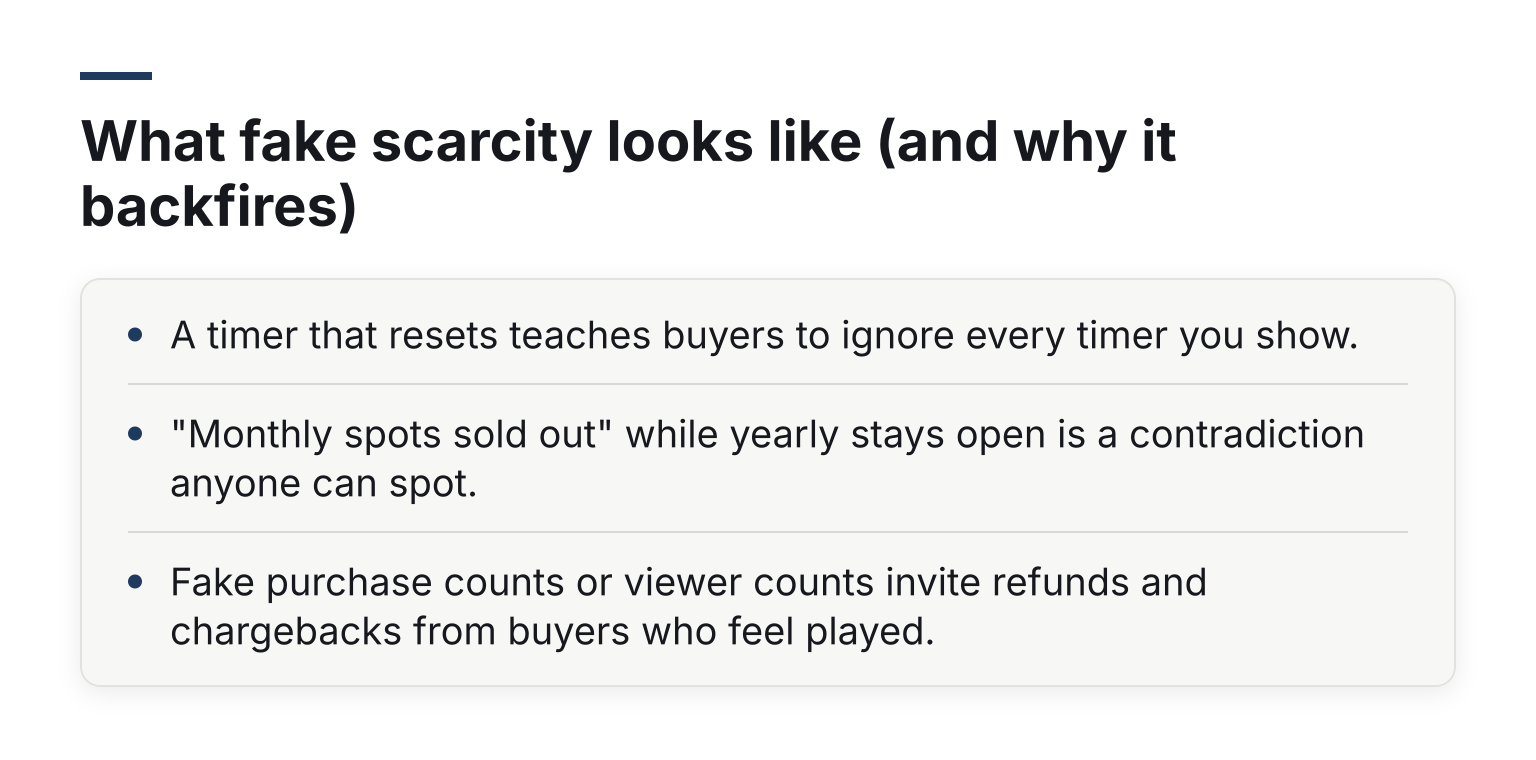
- A timer that resets teaches buyers to ignore every timer you show.
- "Monthly spots sold out" while yearly stays open is a contradiction anyone can spot.
- Fake purchase counts or viewer counts invite refunds and chargebacks from buyers who feel played.
For a concrete contrast: "Enrollment closes Friday at midnight" is credible. "Only 3 left in stock" on a downloadable PDF is not.
An ethics checklist before you publish urgency
Run every deadline through these questions:
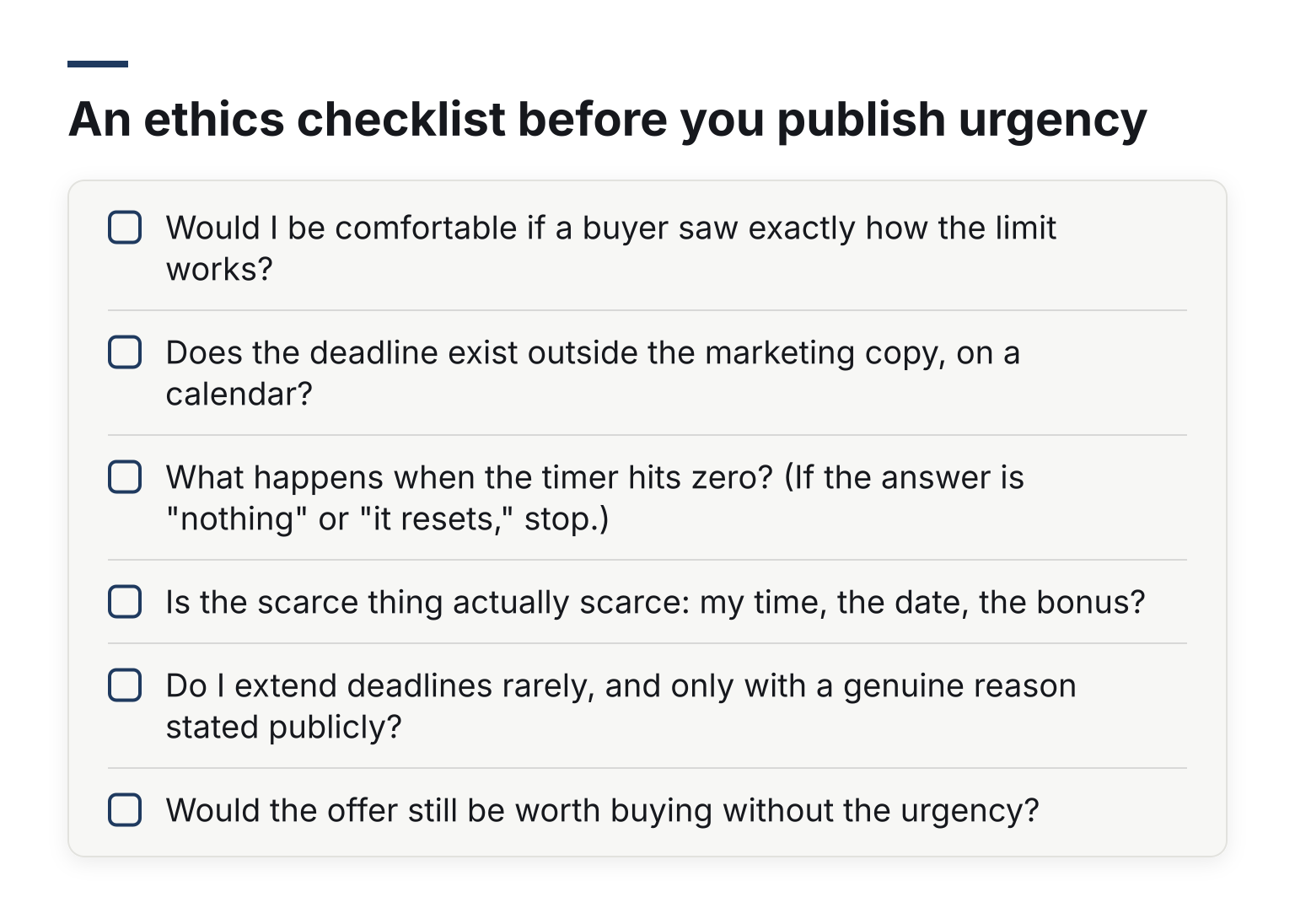
- Would I be comfortable if a buyer saw exactly how the limit works?
- Does the deadline exist outside the marketing copy, on a calendar?
- What happens when the timer hits zero? (If the answer is "nothing" or "it resets," stop.)
- Is the scarce thing actually scarce: my time, the date, the bonus?
- Do I extend deadlines rarely, and only with a genuine reason stated publicly?
- Would the offer still be worth buying without the urgency?
If any answer is no, fix the offer before the copy.
Where each tactic lives in the funnel
Urgency isn't one page. Match the tactic to its place:
- Sales page: launch windows, seat caps, bonus stacks, price deadlines.
- Checkout page: deadline framing at the point of payment, the final "cart closes tonight" message.
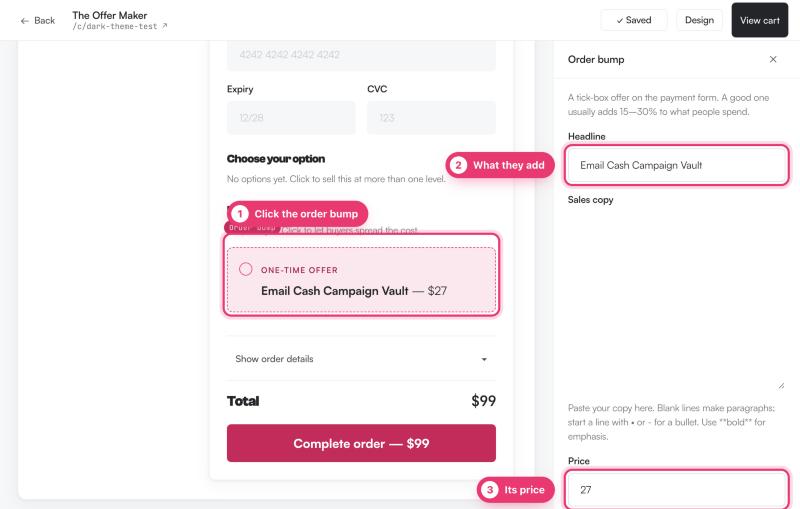
- Order bump: small, time-framed add-ons at the point of purchase.
- One-click upsell page: the "this page only" offer, where urgency is strongest because the buyer is one click from done.
If you're building the page where most of this copy lands, start from a checkout page checklist for digital products. And to set expectations about what urgency can do: my own checkout converted at 6.06% across 30,911 visitors, with scarcity doing the final push, not the heavy lifting.
Implementing urgency at checkout
Whatever tactic you pick, the deadline needs to show up cleanly at the point of payment. That's where checkout tools come in: deadline framing on the checkout page, cart-close windows for launches, and order bumps and one-click upsells as the natural home for time-limited bonus offers.
This is why we built Swipefast the way we did. Every plan, including Starter at $29/month, includes order bumps and one-click upsells, so a time-limited bonus doesn't require an upgrade. You connect your own Stripe or PayPal, get paid directly, and can shape the checkout copy around whatever honest deadline you're running. See Swipefast pricing: Starter $29, Pro $49 a month for the full breakdown.
One caution from this list applied to tools: don't buy a feature you'll be tempted to misuse. A countdown-timer widget is worthless, or worse, if there's no real deadline behind it.
Pick two tactics and make them true
You don't need all 15. Most sellers do well with one calendar-based tactic (a cart close or cohort deadline) and one bonus-based tactic (an expiring bonus or early-bird price). Set the deadline, honor it in public, and let the constraint be real. That's the whole ethical playbook.
If you want somewhere to run them, start a 7-day free trial of Swipefast. You can build your first checkout, add a bump and a one-click upsell, and have your honest deadline live before the trial ends.
Questions people ask before choosing
Can I add more than one order bump?
Yes. Every plan has unlimited order bumps, and each checkout can show several.
Does the bump charge the card again?
No. The bump is added to the same payment, so the buyer pays once.